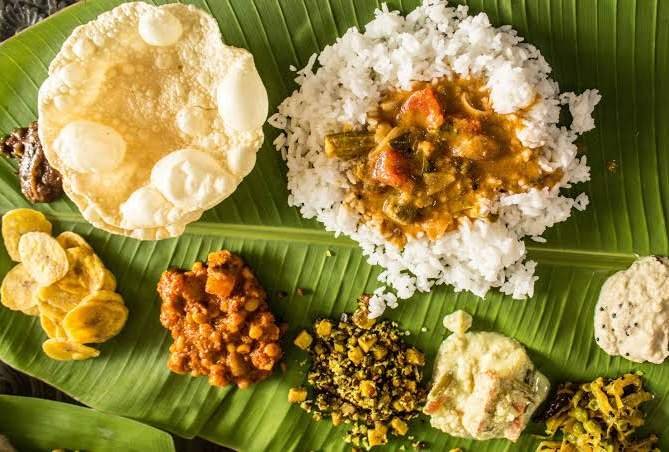
There is a particular moment in Kerala when a meal stops being just a meal.
It happens when a long green banana leaf is placed in front of you, freshly washed and still carrying the faint smell of the plant from which it came. Someone adjusts it carefully, making sure the pointed end faces the correct direction. Then, almost as if following an old piece of music, people begin to serve.
A little salt.
A spoonful of pickle.
Banana chips.
Papadam.
A small mound of thoran.
Avial.
Olan.
Pachadi.
Kichadi.
Erissery.
Kootu curry.
The leaf begins to fill.
You look at it and wonder how so many things could possibly fit on one leaf.
Then comes the rice.
And suddenly you understand.
This is not simply lunch.
This is a Sadya.
In Malayalam, sadya means a feast or banquet. It is one of Kerala’s great food traditions, served at weddings, temple celebrations, family occasions, Vishu and, most famously, during Onam. The Onasadya is the grand festive version associated with Thiruvonam. Kerala Tourism describes Sadya as a traditional vegetarian feast that can stretch to 20, 28 or even more dishes, depending on the occasion.
But the number of dishes is not really the story.
The story is the banana leaf.
The story is the order.
The story is the person who knows exactly where everything belongs without needing to think.
And the story is how an entire culture has managed to turn a collection of vegetables, lentils, coconut, yoghurt, rice, banana and jaggery into one of the most memorable meals in India.
Before the first bite
A Sadya begins long before the first curry reaches the leaf.
In Kerala homes, especially during Onam, preparations can begin a day or two in advance.
There are vegetables to buy.
Coconut to grate.
Bananas to cut.
Pickles to prepare.
Payasam to simmer.
Papadams to fry.
Chips to slice and fry.
The kitchen becomes a place of constant movement.
Someone is washing vegetables.
Someone is cutting beans.
Someone is scraping coconut.
Someone is standing over a large vessel of sambar.
Someone is tasting the payasam and deciding whether it needs more jaggery.
There is conversation everywhere.
Children come into the kitchen asking when lunch will be ready.
They are sent away.
They come back.
They are sent away again.
And somehow they still manage to steal a banana chip.
This is the part of Sadya that photographs cannot fully capture.
A photograph can show twenty dishes on a leaf.
It cannot show the hours of work behind them.
It cannot show the tiredness of the person who has been cooking since morning.
It cannot show the pride when everyone finally sits down.
And it cannot capture that wonderful moment when the first person says, “Come, come, eat before it gets cold.”
The leaf is the first plate
Traditionally, Sadya is served on a fresh plantain leaf, with the narrow, tapering end pointing towards the diner’s left. The rice is generally placed on the lower portion of the leaf, closest to the person eating, while the smaller side dishes occupy the upper section.
This arrangement may look decorative to an outsider.
It is not.
The leaf is part of the experience.
It is your plate.
It is your table.
It carries the food, the aroma and even a little of the heat from the meal.
When hot rice is placed on it, the leaf releases a gentle green fragrance. When sambar or parippu touches the rice, the smell changes. Coconut oil, curry leaves, roasted spices, jaggery and ripe banana all begin to exist together.
And then there is the practical beauty of it.
After the meal, there is no porcelain plate to wash.
The leaf is folded and disposed of naturally.
But there is something more intimate about eating from a banana leaf.
It makes the meal feel temporary.
You are not collecting food.
You are experiencing it.
The leaf is green in the beginning.
By the end, it is almost empty.
And that is exactly how it should be.
What exactly is on the banana leaf?
This is where the first-time Sadya eater can become completely confused.
You may see twenty or more small portions and have no idea what any of them are.
Do not worry.
Even the order can vary between northern, central and southern parts of Kerala, and between homes, temples and communities. One account from Kerala notes regional differences in serving sequence, including variations in how katti parippu, sambar, rasam, payasam and buttermilk are served.
So there is no single sacred checklist that every Sadya follows.
But there is a familiar family of dishes.
Let us walk across the leaf.
Uppu — Salt
The smallest item may be the most basic.
Uppu means salt.
A tiny pinch of salt is traditionally placed on the leaf, often towards the upper left.
It looks almost insignificant among all the other dishes.
But salt is the quiet beginning of the meal.
It reminds you that this is food before it becomes a feast.
Pappadam — The crisp companion
Then there is pappadam.
Thin, crisp and usually made from black gram flour, pappadam is fried until it becomes light and brittle.
For many people, it is impossible to imagine a Sadya without it.
You crush it into rice.
You eat it alongside vegetables.
You save a little piece for later.
And, if you are a child, you probably eat some before anyone tells you to start lunch.
Upperi — Banana chips
Then come the famous Kerala banana chips, or upperi.
These are thin slices of banana fried until crisp.
They are salty, crunchy and addictive.
Kerala’s traditional Sadya also commonly includes sharkara upperi, banana pieces coated with jaggery and spices. Kerala Tourism lists both banana chips and sarkaravaratti among the characteristic elements of an Onasadya.
The two are very different.
One is crisp and salty.
The other is sweet, sticky and deeply aromatic.
Together they tell you something important about Sadya.
There is no fear of contrast.
Sweet can sit beside salty.
Sour can sit beside creamy.
Bitter can sit beside sweet.
Everything has a place.
Pazham — The ripe banana
A ripe Nendran banana is another familiar presence.
The banana may seem like an odd thing to place beside curries and rice.
Until the payasam arrives.
Then everything makes sense.
A piece of ripe banana mashed into payasam creates a rich, sweet mouthful.
Some people also simply eat the banana on its own.
It is both an accompaniment and part of the dessert experience.
Pickles: the little explosions
A Sadya without pickle would feel strangely incomplete.
Manga achar is mango pickle, sharp and salty.
Naranga achar is lime or lemon pickle, sour, salty and often hot.
Then there is one of the most memorable items on the leaf:
Inji Puli
Inji puli, also called puli inji, is made primarily with ginger, tamarind and jaggery, producing a flavour that is simultaneously spicy, sour and sweet.
It is one of those foods that makes you stop for a second.
First comes the ginger.
Then the tamarind.
Then the sweetness.
Then another little kick of spice.
Kerala Tourism includes ginger pickle, mango pickle and lime pickle among the traditional Sadya accompaniments.
Inji puli is especially interesting because it behaves almost like a bridge between the different parts of the meal.
It can wake up your mouth when everything starts feeling rich.
And believe me, after ten or fifteen dishes, you may need something to wake up your mouth.
Thoran — Vegetables, coconut and simplicity
Now we reach the vegetable dishes.
Thoran is one of the most familiar.
It is a dry preparation of vegetables cooked with grated coconut, often with mustard seeds, curry leaves and chillies.
Cabbage thoran is common.
Beans thoran is common.
Carrot, beetroot, long beans and other vegetables can also be used.
What makes thoran beautiful is that the vegetable remains recognisable.
It does not disappear beneath a heavy gravy.
You can still taste what you are eating.
That is a quality shared by many Sadya dishes.
The food does not need to be complicated to be celebratory.
Avial — The great mixed-vegetable dish
If there is one Sadya dish that people outside Kerala often know, it is probably avial.
Avial is a thick vegetable preparation made with a combination of vegetables, coconut and green chilli, usually finished with coconut oil and curry leaves. Kerala Tourism describes it as one of the essential side dishes of Sadya.
The vegetables can include raw banana, yam, drumstick, ash gourd, carrot, beans and other seasonal choices.
The important thing is that avial should not taste like an ordinary mixed vegetable curry.
It has a distinct freshness.
The coconut gives it body.
The vegetables give it texture.
The yoghurt used in many versions gives it a gentle sourness.
And the final drizzle of coconut oil gives the whole thing that unmistakable Kerala character.
Every family has opinions about avial.
Too much yoghurt?
Someone will complain.
Too little coconut?
Someone will notice.
Vegetables cut too small?
Definitely an argument.
This is how you know a dish has become part of culture.
People have strong opinions about it.
Olan — Quiet, soft and gentle
After the stronger flavours, olan can feel almost shy.
It is generally made with ash gourd and cowpeas or red gram, cooked gently with coconut milk and finished with coconut oil.
There is no need for loud spice.
Olan is mild.
Soft.
Creamy.
It gives the tongue somewhere to rest.
Kerala Tourism describes olan as a relatively bland preparation of pumpkin and pulses cooked with thin coconut milk.
In a meal filled with pickles, chillies, tamarind and fried foods, that gentleness matters.
Sadya is not about making every dish exciting.
It is about making the whole meal exciting.
That is an important distinction.
Erissery — Sweetness from vegetables
Then there is erissery.
Pumpkin and black-eyed peas are commonly used, along with coconut and spices.
The sweetness of pumpkin sits comfortably with the savoury elements.
Erissery is another example of how Kerala cooks work with natural sweetness rather than simply adding sugar.
It can be particularly beautiful when the pumpkin is cooked until soft but not completely lost.
The coconut gives it a nutty richness.
The roasted coconut garnish in some versions adds another layer.
It is simple food, but it feels festive.
Kootu Curry — Where sweet and savoury meet
Kootu curry is another important Sadya preparation.
It commonly combines vegetables such as raw banana and yam with chickpeas or other legumes, coconut and spices.
It is thicker and more substantial than many of the other vegetable preparations.
The roasted coconut used in some versions gives it a deeper, darker flavour.
It is the kind of dish that feels designed for rice.
Not delicate.
Not fragile.
Comforting.
It sits somewhere between a vegetable curry and a lentil preparation, and it adds another texture to an already crowded meal.
Pachadi — Kerala’s cool, creamy side
Now comes pachadi.
Pachadi is generally a yoghurt-based preparation combined with vegetables or fruit and a coconut mixture.
Pineapple pachadi is a popular festive version.
Beetroot pachadi is another.
There are also versions made with cucumber and other ingredients.
The sweetness or freshness of the fruit or vegetable works beautifully with the sourness of yoghurt.
And then mustard seeds and curry leaves bring everything back into the familiar Kerala flavour profile.
Kichadi — Sour, cooling and sharp
Kichadi may look similar to pachadi if you are seeing both for the first time.
But the preparation and flavour can differ.
Cucumber or bitter gourd are commonly used, with yoghurt, coconut and a tempering of mustard seeds and curry leaves.
Some versions use okra.
This is where the Sadya begins to show its great talent for balance.
A little sourness.
A little spice.
A little sweetness.
A little cooling yoghurt.
You begin to understand why twenty dishes do not necessarily taste like twenty unrelated foods.
They are designed to speak to one another.
Kaalan — Thick, sour and comforting
Kaalan is another yoghurt-based curry, but it is thicker and more substantial.
Raw banana and yam are commonly used, cooked with yoghurt and coconut.
The sourness is important.
Kaalan can be more intense than the gentler pachadi and kichadi.
It is another dish that reminds us that yoghurt in Kerala cooking is not merely a cooling accompaniment.
It is a major source of flavour.
Pulissery — The soft ending of the curry world
Then there is pulissery, a mildly sour yoghurt-based curry that can be made with vegetables or fruits.
Pineapple, mango and cucumber are among the ingredients used in different versions.
The exact preparation varies from family to family.
But the underlying idea remains the same: yoghurt, coconut and a gentle balance of sour, sweet and savoury.
By this stage of the meal, you may already have eaten enough.
But the Sadya is not finished.
Not even close.
Parippu — The beginning of the rice
Eventually, rice arrives.
Traditionally, Kerala Sadya uses parboiled red rice, often called matta rice.
It is placed in the centre or lower part of the leaf, closest to the diner.
And then comes parippu.
This is one of the most important moments of the meal.
Parippu is a lentil curry, commonly prepared with dal and served with a little ghee.
Kerala Tourism identifies parippu as the first curry served with rice in the traditional Sadya sequence.
There is something almost comforting about this beginning.
After all those little side dishes, you finally have rice.
A spoonful of parippu.
A little ghee.
Mix it.
Eat.
And suddenly the meal becomes warm and substantial.
Sambar — The main river of the meal
Then comes sambar.
Vegetables, lentils, tamarind and spices come together in this famous South Indian curry.
In Kerala Sadya, sambar is not simply another curry.
It marks a new stage of the meal.
Rice and sambar become the centre.
You mix them together with your fingers.
The rice absorbs the curry.
The vegetables give texture.
The tamarind adds sourness.
The spices warm the mouth.
And suddenly all those side dishes you tasted earlier begin to make sense.
You can mix a little avial into the rice.
A little thoran.
A piece of pickle.
A little pappadam.
There are endless combinations.
The leaf becomes a map.
You are no longer eating individual dishes.
You are composing your own mouthfuls.
Rasam — The sharp turn
After the richness of sambar comes rasam.
Thin.
Peppery.
Sour.
Spicy.
A rasam made for Sadya can feel almost medicinal in the best possible way.
It is light and fragrant, often built around tamarind, pepper, chilli and spices.
Kerala Tourism places rasam after the sweeter part of the meal in the traditional sequence, though serving orders vary by region. (Kerala Tourism)
Rasam is not trying to compete with sambar.
It changes the direction of the meal.
It clears the palate.
It wakes you up.
And just when you think the meal is moving towards its end, something unexpected happens.
Dessert arrives.
Payasam — Sweetness in the middle of the feast
Payasam is not merely dessert at the end of a Sadya.
It can arrive as a whole event.
A Sadya may have more than one payasam.
Sometimes two.
Sometimes three.
Sometimes several varieties.
Kerala Tourism lists versions including Ada Pradhaman, Palada, Parippu Pradhaman, vermicelli payasam and milk-based preparations. (Kerala Tourism)
And this is where the banana becomes important.
You take a piece of ripe banana.
Add some payasam.
Maybe add a little papadam.
Yes, papadam.
If you have never tried the combination, it sounds strange.
Then you taste it.
And you understand why people have been doing this for generations.
Ada Pradhaman
Made with pieces of ada — rice flakes — coconut milk and jaggery, ada pradhaman is dark, rich and deeply aromatic.
Palada Payasam
Palada is a milk-based payasam made with rice ada, milk and sugar.
It is lighter in colour and very different from ada pradhaman.
Parippu Pradhaman
This uses lentils, jaggery and coconut milk.
It sounds unusual until you taste it.
The lentil provides body.
The jaggery gives sweetness.
The coconut milk makes it rich.
Semiya Payasam
Vermicelli cooked in milk with sugar, often finished with nuts and raisins.
Not every Sadya will contain all of these.
That is one of the things worth remembering.
There is no single universal Sadya menu.
The number of dishes and the exact payasam selection can change from place to place and family to family. (Tadka Table)
The second rice
You might think that after payasam, the meal is finished.
But traditional Sadya has another turn.
Rice returns.
And now it is usually paired with something sharper and lighter.
Perhaps rasam.
Perhaps pulissery.
Perhaps moru.
Perhaps a regional variation.
The meal begins to wind itself down.
Moru — The final cooling note
Moru is buttermilk.
Simple.
Sour.
Refreshing.
It may be served plain, salted and flavoured with ginger, green chilli or herbs.
Kerala Tourism describes the arrival of sour buttermilk as the final stage of the traditional feast. (Kerala Tourism)
After the richness of rice, sambar, vegetables and payasam, moru feels almost like opening a window.
The body knows lunch is ending.
The mind begins to slow down.
Someone nearby is probably already leaning back.
Someone else is asking for more payasam.
And there is always one person who says:
“I can’t eat another thing.”
Then takes another banana chip.
Why so many dishes?
This is perhaps the biggest question outsiders ask.
Why twenty dishes?
Why not five?
Why make one lunch so elaborate?
The answer is not simply that Keralites like food.
Although, as a food lover myself, I would happily accept that explanation.
The deeper answer is hospitality.
A Sadya is designed to offer abundance.
It says:
There is enough.
There is enough rice.
Enough vegetables.
Enough sweets.
Enough for the guest.
Enough for the neighbour.
Enough for the entire family.
During Onam, this feeling becomes especially powerful.
Onam is associated with ideas of prosperity, equality, homecoming and celebration, and the Onasadya is at the heart of the festive meal. Kerala Tourism describes the feast as an important part of Onam and a tradition that brings family members together. (Kerala Tourism)
The meal is therefore not simply a demonstration of cooking skill.
It is an expression of generosity.
The cook is the invisible hero
Whenever I see a beautifully arranged Sadya, I think about the people who cooked it.
We tend to photograph the banana leaf.
We photograph the colours.
We photograph the payasam.
But the real masterpiece is the kitchen.
Imagine preparing twenty or thirty dishes that all need to be ready around the same time.
Some need to be cooked slowly.
Some need to be fried at the last moment.
Some need to remain warm.
Some must not become watery.
Some need fresh coconut.
Some need yoghurt.
Some need tempering just before serving.
And then everything has to reach the dining area.
This is not casual cooking.
It is choreography.
In a traditional household, the experienced cook may not even need a written list.
The hands know.
The eyes know.
The nose knows.
The sound of mustard seeds popping in hot coconut oil is enough to tell you that the tempering is ready.
The smell of roasted coconut tells you another dish is almost done.
The consistency of payasam tells you whether it needs another few minutes.
This knowledge is rarely written down.
It is inherited.
The order matters, but not as much as we think
One of the most fascinating things about Sadya is the importance given to sequence.
The meal is not simply dumped onto the leaf.
Different items arrive at different moments.
Kerala Tourism describes the traditional sequence beginning with the side dishes, followed by rice and parippu, then sambar, with payasam later, followed by another rice course with rasam or curd-based preparations and finally buttermilk. (Kerala Tourism)
But regional variations are real.
Northern Kerala may serve certain dishes differently from southern Kerala.
Temple Sadya may have its own customs.
A family may follow the order taught by a grandmother.
Another family may laugh at that order and do something completely different.
That is not a contradiction.
That is how food traditions survive.
They remain recognisable without becoming frozen.
A meal that belongs to everyone
There is another beautiful thing about Sadya.
When everyone sits down, the meal becomes democratic.
The same banana leaf.
The same rice.
The same vegetables.
The same payasam.
A guest and a member of the family can sit beside each other.
Everyone is served.
Everyone eats.
Everyone is part of the occasion.
This is particularly meaningful during Onam, when the Sadya is associated with celebration and the ideal of abundance.
And there is something very human about being served food by someone else.
You sit down.
You do nothing.
Someone walks towards you with a bucket of sambar.
“More?”
You say no.
They look at your leaf.
They decide you need more.
And before you can object, another spoonful lands beside the rice.
That is hospitality in its purest form.
Eating the Sadya is its own skill
If you have never eaten a traditional Sadya, the first attempt can be confusing.
There is food everywhere.
You don’t know what to mix.
You don’t know where to begin.
Everyone else seems to know exactly what they are doing.
The important thing is not to panic.
Start small.
Taste the side dishes individually.
Then take some rice.
Try parippu with ghee.
Then sambar.
Mix the rice gently with your fingers.
Try a little thoran.
A little avial.
A little pickle.
Then move towards rasam.
Then payasam.
The best part is discovering your own combinations.
One mouthful may be rice and sambar.
The next might be rice, avial and pickle.
Then a little payasam with banana.
Then a piece of papadam.
There is no single correct way to experience the whole feast, even though the overall sequence has traditional patterns.
The leaf gives you freedom inside the structure.
When the leaf is empty
Eventually, the banana leaf begins to show through.
The bright green surface is now covered with little traces of curry.
A few grains of rice remain.
Perhaps one stubborn piece of banana chip.
The payasam has disappeared.
The papadam is gone.
Someone asks if you want more.
You look at your stomach.
Your stomach says no.
Your heart says yes.
And this is when you understand the real story behind Sadya.
It is not about twenty dishes.
It is not about twenty-five dishes.
It is not even about Onam.
It is about the idea that food can be a way of welcoming someone into your home, your community and your memory.
The banana leaf is only the beginning.
The final fold
At the end of a Sadya, the leaf is folded.
There are regional and situational customs around how it is folded, so I would be cautious about treating one particular direction as a universal rule.
What matters more is the feeling of completion.
The meal is over.
The leaf has done its work.
The kitchen can finally rest.
The people who cooked can sit down.
Someone will probably ask for tea.
Children will disappear.
Older people will continue talking.
And somewhere, in the kitchen, there will still be a little payasam left.
Someone will quietly put it into a bowl.
Because a Sadya never really ends when the banana leaf is folded.
Its flavours stay.
More than a feast
Kerala on a banana leaf is easy to describe as an extravagant vegetarian meal.
But that description misses something.
Sadya is not extravagant simply because there are many dishes.
It is extravagant because of the thought behind those dishes.
A bitter note.
A sour note.
A sweet note.
Something crisp.
Something soft.
Something creamy.
Something spicy.
Something mild.
Something fried.
Something fermented or pickled.
Something fresh.
Something cooling.
Then rice.
Then dessert.
Then buttermilk.
The meal moves like a story.
It begins with small tastes.
It becomes fuller.
It reaches its richest point.
Then it becomes sweet.
Then it becomes light again.
That is why the Sadya feels almost like a carefully written piece of music.
Each dish has a role.
No single dish needs to dominate.
Together they become something larger.
The banana leaf remembers
Years after eating a Sadya, people may forget exactly what they ate.
They may not remember whether the thoran was beans or cabbage.
They may forget which payasam was served.
They may not remember whether the pachadi was pineapple or beetroot.
But they remember the leaf.
They remember sitting beside other people.
They remember the sound of serving spoons.
They remember the smell of coconut oil.
They remember breaking papadam into rice.
They remember the first taste of payasam.
They remember being told, “Have some more.”
And perhaps that is why the Sadya has survived.
Because food traditions do not survive simply because recipes are written down.
They survive because people associate them with happiness.
With family.
With festivals.
With weddings.
With home.
With the feeling that, for one afternoon, there is more than enough.
More than enough rice.
More than enough vegetables.
More than enough sweets.
More than enough time.
And more than enough love.
So the next time a banana leaf is placed in front of you and someone begins filling it with little spoonfuls of Kerala, do not rush.
Look at it for a moment.
Notice the salt.
The pickle.
The chips.
The pappadam.
The thoran.
The avial.
The olan.
The erissery.
The kootu curry.
The pachadi.
The kichadi.
The kaalan.
The pulissery.
The rice.
The ghee.
The parippu.
The sambar.
The rasam.
The payasam.
The banana.
The moru.
There may be more.
There may be fewer.
That is perfectly all right.
Because a Sadya was never meant to be counted only in numbers.
It is counted in the people sitting around the leaf.
In the hands that cooked the food.
In the person who serves you one more spoonful even when you say you are full.
And finally, in the empty banana leaf in front of you.
That empty leaf is perhaps the greatest compliment you can give the person who cooked.
You ate.
You enjoyed.
You belonged, at least for one meal, to the great Kerala tradition of sitting down together and sharing abundance.
And somewhere in the kitchen, someone is already asking the most important question of all:
“Who wants some more payasam?”