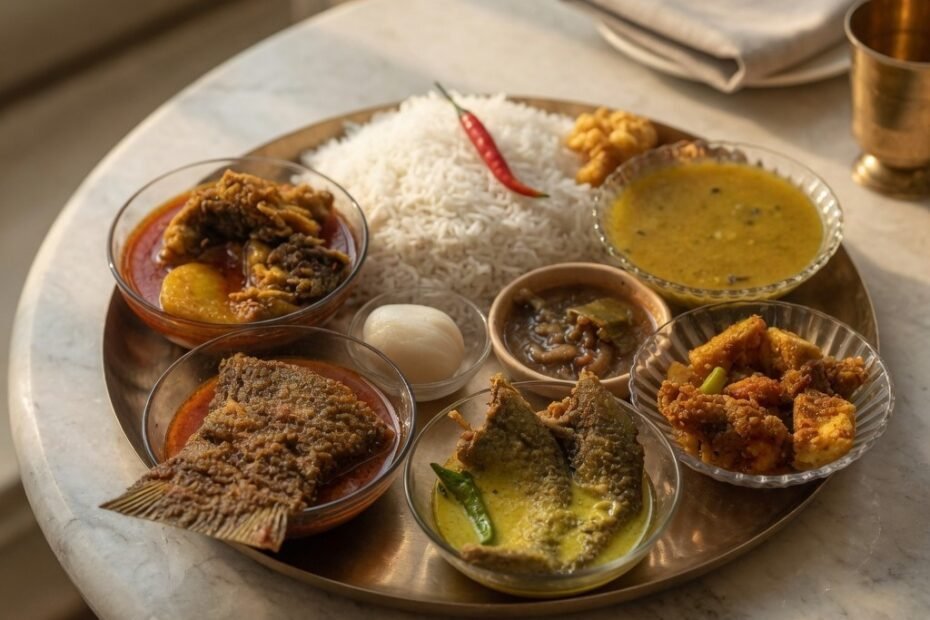
There is an old saying in Bengal that a Bengali’s emotions are hidden inside the kitchen. After living more than seventy years and spending most of my life cooking for a large family, I can say this is very true. In our homes, food is not simply for filling the stomach. Food carries memories, love, festivals, seasons, and family traditions.
Even today, when I wake up early in the morning and hear the sound of the haata-khunti in the kitchen, my heart becomes peaceful. I remember my mother cooking near the old coal oven in our ancestral house near Krishnanagar. I remember the smell of freshly ground shorshe bata, the sound of fish frying in mustard oil, and the soft steam rising from hot white rice.
In Bengal, cooking is part of life itself.
A Bengali kitchen changes with the seasons. During summer, we eat light and cooling dishes. During monsoon, we crave fried foods with hot tea. In winter, homes become filled with the smell of nolen gur. During Durga Puja, every house prepares special dishes for family and guests.
The food of West Bengal reflects its rivers, villages, festivals, literature, and emotions. Every traditional Bengali dish carries a small piece of our heritage.
Today many young people know biryani, pizza, burgers, and noodles very well. But the old dishes slowly disappearing from Bengali homes carry stories that deserve to be remembered.
Bengali Food and the Importance of Simplicity
One thing outsiders often misunderstand about Bengali food is that they think it is always rich and spicy. That is not true. Real Bengali home cooking is often very simple.
A proper Bengali meal begins gently and slowly. We do not attack the stomach with heavy spices from the beginning. There is a rhythm in our meals.
First comes something bitter like shukto or fried bitter gourd. Then comes dal, vegetables, fish, and finally chutney and sweets. Every dish has its place and purpose.
Even poor families in villages tried to maintain this structure with whatever ingredients they had.
That is the beauty of Bengali food. It respects balance.
My grandmother used to say, “Ranna holo moner byapar.” Cooking is a matter of the heart. If the mind is restless, even good ingredients cannot create good food.
That old wisdom still feels true today.
The Deep Connection Between Bengal and Fish
People across India joke that Bengalis can eat fish every day for their entire life. Honestly, they are not wrong.
Fish is deeply connected with Bengali identity. The rivers of Bengal have shaped our food culture for centuries. The Ganga, Padma, Teesta, and countless ponds and wetlands provided fresh fish to ordinary homes.
In Bengali weddings, fish is considered auspicious. During festivals, large fish are gifted to relatives. Even old village rituals often included fish offerings.
Among all fish, ilish maachh holds a special emotional place. During monsoon season, the arrival of hilsa in markets creates excitement across Bengal. Families discuss prices, quality, and recipes with great seriousness.
Then there is rui maachh, katla, pabda, parshe, chingri, and many more.
But Bengali cooking never tries to overpower fish with heavy masala. The natural flavor remains important.
A little mustard oil, green chili, turmeric, and fresh coriander are often enough.
That simplicity reflects Bengali culture itself.
Shorshe Bata and the Soul of Bengali Cooking
If I had to choose one ingredient that represents Bengal, I would choose mustard.
Mustard oil and mustard paste are the heart of countless Bengali dishes. The sharp smell of hot mustard oil immediately reminds me of childhood afternoons in my mother’s kitchen.
In old days, mustard paste was prepared fresh on a shil nora, the flat grinding stone found in Bengali homes. My mother would sit patiently grinding soaked mustard seeds with green chilies until the paste became smooth and fragrant.
Today mixers have replaced those stones, but the taste never feels exactly the same.
Dishes like shorshe ilish, begun bhapa, and shorshe chingri depend on mustard for their identity.
Mustard reflects Bengal perfectly. Strong, sharp, emotional, and unforgettable.
Rice: The Heart of Every Bengali Meal
A Bengali meal feels incomplete without rice.
Hot steamed rice, or bhaat, remains central to our food culture. In villages, farmers worked long hours in paddy fields under the sun. Rice gave strength and comfort.
Even today, the smell of fresh rice can bring back memories of home for Bengalis living far away.
Different regions of Bengal developed their own rice traditions. During festivals, special rice preparations like khichuri, pulao, and payesh become important.
Rainy days and khichuri are almost inseparable in Bengal. When dark clouds gather and rain hits the windows, many Bengali homes immediately prepare hot khichuri with fried vegetables and omelette.
Food here is always connected with weather, mood, and memory.
Shukto: The Forgotten Taste of Old Bengal
Modern children often dislike shukto because of its slight bitterness. But older Bengalis understand its importance.
Shukto is one of the oldest traditional Bengali dishes. It is usually served at the beginning of meals and contains mixed vegetables with gentle bitterness.
My grandmother believed bitter food cooled the body and improved digestion. But beyond health, shukto also represents an old Bengali philosophy.
Life itself contains bitterness.
And learning to appreciate gentle bitterness is part of growing older.
Traditional shukto often includes bitter gourd, raw banana, potato, drumsticks, and brinjal cooked in a lightly spiced gravy with milk or mustard paste.
It is not flashy food. It is thoughtful food.
Durga Puja and the Food of Celebration
No discussion of Bengali food culture is complete without Durga Puja.
Ah, those days.
Even now, when I hear dhaak during Puja season, my heart becomes emotional. Bengali homes become filled with guests, laughter, and endless cooking.
Special dishes are prepared for family members coming from distant places. Large pots of khichuri, labra, chutney, and sweets are cooked for bhog.
In old neighbourhoods, women gathered together to cut vegetables while discussing family gossip and Puja shopping.
Food during Durga Puja is not about luxury. It is about togetherness.
Even simple bhoger khichuri cooked inside temple compounds tastes heavenly because it carries devotion and community spirit.
Sweets and the Emotional Nature of Bengalis
People say Bengalis are emotional. Looking at our sweets, perhaps it is true.
Bengal’s sweet culture is world famous. But sweets here are not simply desserts. They are part of social life.
Guests are welcomed with sweets. Good news is shared with sweets. Festivals feel incomplete without sweets.
In my younger days, sweet shops prepared fresh sweets several times a day because people wanted everything fresh.
Rosogolla, sandesh, pantua, mihidana, chomchom, and payesh all carry regional pride and history.
But among all sweets, I personally love simple homemade payesh the most.
Slowly cooked milk, fragrant rice, and jaggery create something deeply comforting.
Even today, many Bengali mothers prepare payesh on birthdays for blessings and good fortune.
Recipe 1: Simple Aloo Posto
This humble dish represents everyday Bengali comfort food.
Ingredients
- 3 potatoes cut into cubes
- 3 tablespoons posto or poppy seeds
- 2 green chilies
- Mustard oil
- Salt
- Turmeric
Method
- Soak the posto for 20 minutes.
- Grind posto with green chilies into a smooth paste.
- Heat mustard oil in a pan.
- Add potatoes with turmeric and salt.
- Fry lightly for a few minutes.
- Add posto paste and little water.
- Cover and cook until potatoes become soft.
- Serve hot with rice.
Aloo posto may look simple, but for many Bengalis it carries childhood memories.
The Role of Women in Preserving Bengali Food Culture
In old Bengali homes, women carried food traditions from one generation to another.
Recipes were rarely written down. Cooking was taught through observation and practice. Daughters learned by standing beside mothers and grandmothers in the kitchen.
Measurements were never exact.
A little of this.
A handful of that.
Enough salt “according to understanding.”
Even today, I cook like that.
Modern kitchens have measuring cups and digital scales, but old Bengali cooking depended more on instinct.
Women also adjusted recipes according to seasons, finances, and family needs. During difficult times, they still created satisfying meals with very little.
That quiet creativity deserves respect.
Recipe 2: Traditional Begun Bhaja
Few dishes are simpler and more comforting than this.
Ingredients
- 1 large brinjal
- Turmeric
- Salt
- Red chili powder
- Mustard oil
Method
- Slice the brinjal into thick pieces.
- Rub with turmeric, salt, and chili powder.
- Heat mustard oil properly.
- Fry the brinjal slices until golden brown outside and soft inside.
- Serve with dal and rice.
A plate of hot rice, musur dal, and begun bhaja can still make me happier than expensive restaurant food.
The Influence of Rivers and Villages
West Bengal’s food culture was shaped heavily by rivers and agriculture.
Village life taught people to respect seasonal ingredients. During monsoon, fresh fish became abundant. Winter brought cauliflower, peas, carrots, and fresh jaggery.
Summer meals became lighter with dishes like tok dal and cooling vegetables.
Old Bengali cooking wasted very little. Vegetable peels, stems, leaves, and fish heads were used creatively.
Even today, dishes like macher matha diye dal show the resourcefulness of Bengali kitchens.
Food reflected practical wisdom developed over generations.
Recipe 3: Old Style Tomato Chutney
No Bengali feast feels complete without chutney near the end of the meal.
Ingredients
- 3 tomatoes chopped
- 2 tablespoons sugar or jaggery
- 1 dry red chili
- 1 teaspoon mustard seeds
- Oil
- Salt
- Raisins
Method
- Heat oil in a pan.
- Add mustard seeds and dry red chili.
- Add tomatoes and cook until soft.
- Add sugar, salt, and raisins.
- Cook until thick and glossy.
- Cool slightly before serving.
Sweet tomato chutney brings balance after spicy dishes and prepares the mouth for dessert.
Why Bengali Food Is Deeply Emotional
The more I grow old, the more I understand that Bengali food is connected deeply with emotion.
Certain smells can immediately bring back memories of childhood.
The smell of frying fish reminds someone of their mother.
The smell of payesh reminds someone of birthdays.
The smell of khichuri reminds someone of rainy afternoons.
Even simple dishes carry emotional weight because they were cooked with care inside family homes.
Today life has become fast. Many young people eat outside regularly or depend on packaged food. There is nothing wrong with modern life changing. Every generation changes.
But I hope old Bengali dishes never disappear completely.
Because inside those dishes live our stories.
The Heritage of West Bengal Through Food
Traditional Bengali dishes reflect the culture and heritage of West Bengal because they mirror the land and its people.
They show the influence of rivers, farming, festivals, poetry, simplicity, and family bonds.
Bengali food teaches patience. Most dishes are not prepared in great hurry. Mustard paste is ground carefully. Fish is cooked gently. Milk is reduced slowly for sweets.
That slow cooking carries love.
As an old Bengali grandmother who has spent an entire life feeding children, grandchildren, guests, neighbours, and relatives, I can say one thing with full confidence.
People may forget many things in life.
But they never forget the taste of food cooked with affection.
Even today, when my grandchildren visit and ask for hot bhaat, dal, and fried fish, my tired hands somehow find new energy again.
That is the magic of Bengali food.
It fills not only the stomach, but also the heart.