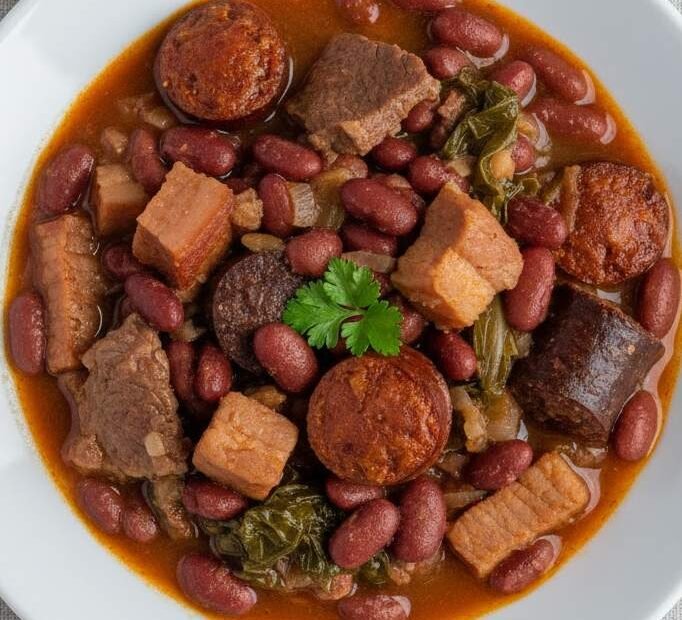
In the rugged, misty hills of Trás-os-Montes, in northern Portugal, where winters bite and hearts are warm, there’s a dish that truly defines comfort — Feijoada à Transmontana. This rich and hearty bean stew is not just food; it’s tradition, celebration, and memory simmered together in one pot.
Unlike the lighter southern dishes of Portugal, Feijoada à Transmontana is bold and filling — a mountain feast made to nourish hardworking families through cold seasons. It’s a medley of beans, pork, beef, sausages, and cabbage, slow-cooked until everything melts together into a thick, flavorful stew. Often served at festivals and family gatherings, this dish carries a sense of home that no other meal quite matches.
The Soul of the Dish
In Trás-os-Montes, cooking is about patience and passion. Every ingredient tells a story. The white or red beans represent abundance, the pork and beef pay homage to traditional farming life, and the chouriço (smoked sausage) adds that unmistakable smoky, garlicky depth of Portuguese cuisine.
When the pot bubbles slowly on the stove, filling the kitchen with its deep aroma, you know something special is happening. Families gather around, chatting, laughing, and waiting — because Feijoada à Transmontana is not a dish to rush. It’s one to savor.
Ingredients
For the Stew:
- 2 cups dry white or red beans (soaked overnight)
- 300 g (10 oz) pork belly, cut into chunks
- 200 g (7 oz) beef chuck, cubed
- 2 chouriço sausages, sliced into rounds
- 1 morcela (blood sausage), sliced (optional but traditional)
- ½ head of cabbage, roughly chopped
- 2 carrots, sliced
- 1 large onion, chopped
- 3 cloves garlic, minced
- 2 bay leaves
- 2 tablespoons olive oil
- 1 tablespoon tomato paste
- ½ teaspoon paprika
- Salt and pepper to taste
- Fresh parsley for garnish
Step-by-Step Recipe
Step 1: Cook the Beans
- Drain the soaked beans and place them in a large pot with enough water to cover them.
- Bring to a boil, then reduce the heat and simmer for about 30–40 minutes, or until tender but not mushy.
- Drain and set aside.
Step 2: Prepare the Meats
- In a large heavy-bottomed pot, heat olive oil over medium heat.
- Add pork belly and beef cubes, browning them on all sides for about 8 minutes.
- Stir in the chouriço slices, letting them release their rich, smoky oil.
- Add the onion, garlic, and bay leaves. Cook until the onion softens and turns golden.
Step 3: Build the Stew
- Stir in tomato paste and paprika; mix well to coat the meats.
- Add enough water (or beef broth) to cover the contents and bring it to a boil.
- Lower the heat, cover, and let it simmer gently for 45 minutes.
- Add the cabbage and carrots, and continue cooking for another 20 minutes, until vegetables are tender.
Step 4: Add the Beans and Finish
- Stir in the cooked beans and season with salt and pepper.
- If using morcela, add it at this stage and simmer for another 10–15 minutes, allowing all flavors to mingle.
- Once done, remove the bay leaves and adjust seasoning if needed.
Step 5: Serve and Enjoy
Ladle the stew into deep bowls and sprinkle with fresh parsley. Feijoada à Transmontana is best enjoyed with crusty bread or a bowl of white rice on the side — and perhaps a glass of full-bodied red wine from the Douro Valley.
Tips from the Mountains
- Traditionally, families use whatever meats are available — ribs, trotters, or cured ham all work beautifully.
- This stew tastes even better the next day, once the flavors have deepened overnight.
- For a more rustic version, some cooks add turnips or kale instead of cabbage.
Nutrition Facts (Per Serving)
| Nutrient | Amount |
|---|---|
| Calories | ~650 kcal |
| Protein | 45g |
| Fat | 35g |
| Carbohydrates | 30g |
| Fiber | 8g |
| Sodium | Moderate to High (due to sausages) |
Prep and Cook Time
- Prep Time: 25 minutes
- Cook Time: 1 hour 45 minutes
- Total Time: 2 hours 10 minutes
The Taste of Celebration
In northern Portugal, Feijoada à Transmontana isn’t just eaten — it’s celebrated. It’s the centerpiece of family gatherings, especially during holidays or winter festivals, where laughter fills the air and long tables are lined with steaming bowls of this rich stew.
For the people of Trás-os-Montes, this dish symbolizes togetherness. It brings generations to the same table, uniting the old and young in the simple joy of shared food. As one local saying goes, “Comer bem é viver melhor” — to eat well is to live better.
So if you ever find yourself craving a meal that’s both soulful and satisfying, make this rustic Portuguese treasure. Slow down, let it simmer, and savor every bite — because Feijoada à Transmontana is not just stew; it’s a taste of Portugal’s heart and heritage.
