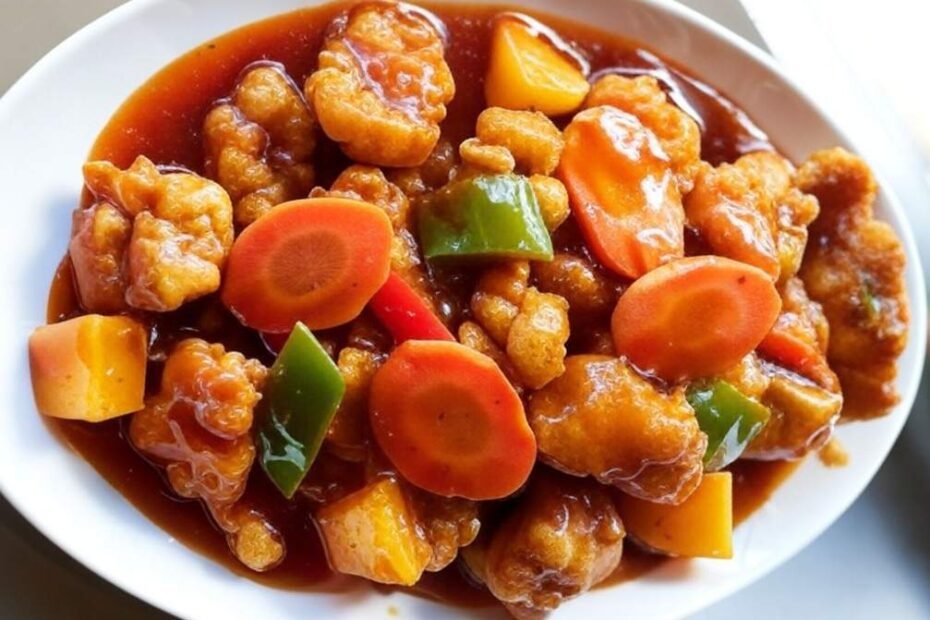
Sweet and Sour Pork, or Gulaorou (咕嚕肉) in Mandarin and Gu Lou Yuk in Cantonese, is arguably one of the most recognizable and beloved Chinese dishes worldwide. Hailing from the culinary heartland of Guangdong (Canton) province, this dish perfectly embodies the Cantonese philosophy of xie tiao (協調) or harmony and balance. It masterfully blends the contrasting tastes of sweetness and acidity with savory fried pork, resulting in a flavor profile that is both complex and incredibly satisfying.
Far from the bright red, sugary versions often found in take-out establishments outside of China, the authentic Cantonese preparation is a refined art. It’s characterized by light, crispy pieces of pork, coated in a glistening sauce that uses natural fruit acids—traditionally from pineapple and sometimes preserved plums—to achieve that signature ‘sour’ punch, balanced by rock sugar and red vinegar.
A History of Harmony and Global Appeal
The origins of Sweet and Sour Pork can be traced back to the 18th and 19th centuries in Guangdong. As Cantonese traders and emigrants ventured out into the world, they took their cuisine with them. The dish was particularly popular in the major port city of Guangzhou.
The legend of its creation often revolves around the need to cater to Western palates. Foreign traders found the traditional Cantonese flavor profiles sometimes too subtle or unfamiliar. Sweet and Sour Pork, with its bold, unambiguous combination of flavors, was immediately accessible. Early versions may have used ribs or even minced meat, but the deep-fried nuggets of pork loin or tenderloin became the standard, designed to soak up the sauce without losing their structural integrity.
This dish’s ability to adapt and travel is why it became a cornerstone of Chinese restaurants globally, sometimes transforming to suit local tastes (e.g., adding ketchup for color and intense sweetness in some regions). However, the soul of the dish—the textural contrast between the crunchy coating and the tender meat, and the meticulous balance of the sauce—remains a testament to Cantonese culinary skill.
The Anatomy of Perfection
To achieve authentic Gu Lou Yuk, three components must be perfected:
- The Pork: Uses tender cuts like pork loin or tenderloin. The meat is marinated for flavor and tenderness, then coated in a light batter (often containing potato starch or cornstarch) and deep-fried twice. The first fry cooks the pork; the second, short, hot fry seals the batter and ensures maximum crunch.
- The Sauce: The true masterpiece. It must be thick enough to coat the pork but not gloopy, with a glossy sheen. The ‘sweet’ comes from sugar or honey, the ‘sour’ from rice vinegar and sometimes hawthorn or preserved plum extract, and the color often from a touch of soy sauce or a natural caramelization.
- The Aromatics & Vegetables: The sauce is always infused with fresh ingredients. Pineapple is essential, providing natural sweetness and acidity. Bell peppers and onions are added at the end for color, flavor, and a fresh crispness that contrasts with the fried pork.
Mastering Sweet and Sour Pork: A Step-by-Step Recipe
This recipe is designed to recreate the light, balanced, and perfectly crispy texture of true Cantonese Sweet and Sour Pork.
Preparation and Cooking Overview
| Category | Time |
| Prep Time | 30 minutes |
| Marinating | 20 minutes |
| Cook Time | 25 minutes (includes double frying) |
| Total Active Time | ~1 hour 15 minutes |
Ingredients
I. The Pork and Marinade
- 1 lb (450g) Pork Loin or Tenderloin, cut into 1-inch cubes
- 1 teaspoon Shaoxing rice wine (or dry sherry)
- 1 teaspoon soy sauce
- 1/2 teaspoon white pepper
- 1/2 teaspoon salt
- 1 teaspoon fresh ginger, minced
II. The Batter
- 1/2 cup all-purpose flour
- 1/2 cup potato starch or cornstarch
- 1/2 teaspoon baking powder
- 1 large egg
- 1/4 cup cold water (or more, until a thick pancake batter consistency)
- Oil for deep frying (vegetable or canola)
III. The Vegetables
- 1 cup fresh Pineapple chunks (canned is acceptable, drained)
- 1/2 medium onion, cut into 1-inch squares
- 1/2 red bell pepper, cut into 1-inch squares
- 1/2 green bell pepper, cut into 1-inch squares
IV. The Sweet and Sour Sauce
- 1/2 cup granulated sugar (or rock sugar)
- 1/4 cup rice vinegar (red or white)
- 3 tablespoons ketchup (for color and flavor depth—a common Cantonese inclusion)
- 2 tablespoons light soy sauce
- 1/2 cup reserved pineapple juice or water
- 1 teaspoon fresh ginger, grated
- 1 tablespoon cornstarch mixed with 2 tablespoons water (slurry)
Instructions
Phase 1: Preparing and Frying the Pork
- Marinate the Pork: In a bowl, combine the pork cubes with the Shaoxing wine, soy sauce, white pepper, salt, and minced ginger. Mix well and let it marinate for at least 20 minutes.
- Make the Batter: In a separate bowl, whisk together the flour, potato starch, and baking powder. Add the egg and cold water. Mix until you have a thick, smooth batter, similar to pancake mix.
- Coat and Fry (First Fry): Toss the marinated pork into the batter, ensuring each piece is fully coated. Heat the oil in a wok or deep pot to $300^\circ\text{F}$ ($150^\circ\text{C}$). Fry the pork in batches for about 3-4 minutes until they are cooked through but still pale. Remove and drain on a wire rack.
- Second Fry (The Crisp): Increase the oil temperature to $375^\circ\text{F}$ ($190^\circ\text{C}$). Return all the par-fried pork to the hot oil and fry for another 1-2 minutes, stirring constantly, until they are deep golden brown and exceptionally crispy. Remove quickly and drain. This double-frying is essential for ultimate crunch.
Phase 2: Making the Sauce
- Combine Sauce Ingredients: In a small bowl, whisk together the sugar, rice vinegar, ketchup, light soy sauce, pineapple juice (or water), and grated ginger. Keep the cornstarch slurry separate.
- Heat the Sauce: Pour the liquid sauce mixture into a clean wok or frying pan and bring it to a simmer over medium heat. Stir continuously until the sugar is fully dissolved.
- Thicken: Once simmering, stir the cornstarch slurry again, pour it into the sauce, and stir rapidly. The sauce will thicken and turn beautifully glossy. Remove from heat immediately.
Phase 3: Assembling the Dish
- Sauté Vegetables: Heat a separate tablespoon of oil in a clean wok or large pan over high heat. Add the onion and bell peppers and stir-fry for 60 seconds. They should remain crisp-tender.
- Add Pineapple: Add the pineapple chunks and stir-fry for another 30 seconds.
- Combine: Pour the prepared sweet and sour sauce over the vegetables and bring the sauce to a quick simmer.
- Final Toss: Immediately add the double-fried, crispy pork pieces into the wok. Toss quickly and gently for about 30 seconds until the pork is coated with the glistening sauce. Serve immediately over rice.
- Pro Tip: Never let the pork sit in the sauce for too long, or the crispness will be lost.
Nutrition Facts and Serving Suggestions
Sweet and Sour Pork, when prepared authentically, offers a balanced meal component with protein, fiber from the vegetables, and carbohydrates from the sauce and accompanying rice. Since it is deep-fried, it is higher in fat than steamed dishes, but its flavor impact is worth the indulgence.
Nutritional Profile
This dish is a good source of protein and provides Vitamins A and C from the peppers and pineapple.
| Component (per serving, estimated) | Value |
| Calories | ~450 – 550 kcal |
| Protein | ~20 – 25 g |
| Total Fat | ~25 – 35 g |
| Carbohydrates | ~35 – 45 g |
| Vitamin C | High (from peppers and pineapple) |
| Iron | Moderate |
Note: These nutritional values are highly variable and depend on the exact portion size, cut of pork, and the amount of oil absorbed during frying.
Serving the Feast
The beauty of Sweet and Sour Pork is its vibrant color and immediate appeal.
- The Staple: It is almost always served over a generous bowl of steamed white rice. The rice absorbs the flavorful excess sauce, completing the meal.
- Aromatic Balance: The dish is rarely served with heavy side dishes, as it contains both vegetables (peppers, onions) and fruit (pineapple). If a side is desired, choose something simple and light, like a clear egg drop soup or blanched Gai Lan (Chinese broccoli) with a light oyster sauce dressing.
- Garnish: For an extra touch of authenticity and fragrance, garnish the finished dish with a sprinkle of toasted sesame seeds or a few freshly chopped scallions.
The Enduring Legacy of Gulaorou
Sweet and Sour Pork’s enduring popularity is not accidental. It’s a dish that engages all the senses: the visual appeal of the vibrant colors (red, green, and golden brown), the immediate aroma of the tangy sauce, and the satisfying crunch of the pork giving way to juicy, seasoned meat.
It is a dish that tells the story of Cantonese innovation—how a local delicacy adapted, traveled, and conquered the global palate, all while staying true to its core principle: the perfect sweet, sour, and savory harmony. The extra step of double-frying is a hallmark of this technique, ensuring that every bite delivers that promised textural contrast that makes authentic Gu Lou Yuk an unforgettable culinary experience.
